




Dry-type transformers are core key equipment in power distribution systems. They refer to transformers whose iron cores and windings are not immersed in insulating oil at all, and rely on solid materials such as air and epoxy resin to achieve insulation and cooling. Compared with traditional oil-immersed transformers, they have extremely high scenario adaptability and are also the preferred selection direction for many distribution projects with high requirements for safety and operation and maintenance costs.
Core Advantages of Dry-Type Transformers
Compared with traditional oil-immersed products, the core characteristics of dry-type transformers fully meet the actual needs of various current distribution scenarios, and their core advantages are reflected in the following aspects:
First, they have outstanding safety performance: they contain no flammable fuel, have the property of being flame-retardant and self-extinguishing, and almost have no risk of fire hazards and oil leakage pollution, making them perfectly suitable for various usage scenarios with high fire prevention requirements.
Second, their operation and maintenance costs are extremely low: there is no need to regularly replace insulating oil during use, and they can almost achieve maintenance-free in daily use. The full-life cycle usage cost is much lower than that of oil-immersed products, which can save users a lot of subsequent operation expenses.
Third, they have strong operation stability: the products have low loss, low operating noise, excellent short-circuit impact resistance, and excellent moisture resistance. They can operate stably for a long time even in high-humidity environments, and rarely have sudden failures.
Finally, they have good installation adaptability: with compact overall size and light weight, they can be directly deployed at the load center without special foundation transformation of the site. The products are equipped with an intelligent temperature control system, which can realize over-temperature automatic alarm and trip protection, further improving operation safety.
Mainstream Classification of Dry-Type Transformers
At present, there are three main classification dimensions for dry-type transformers in the industry, and users can select corresponding types of products according to their own usage needs:
The first category is divided according to insulation processes, covering different types such as epoxy resin casting type (with the highest market share), open non-encapsulated type, wound dry-type transformer, amorphous alloy dry-type transformer, and SF6 gas-insulated dry-type transformer, which adapt to different budget and performance requirements.
The second category is divided according to cooling methods, into natural air cooling and forced air cooling. Products adopting the forced air cooling mode can increase their load capacity by 50%, which is suitable for scenarios where power supply load needs to be increased in a short period of time.
The third category is divided according to structural forms, into three types: ordinary ventilation type, epoxy resin encapsulation and potting type, and fully enclosed non-ventilation type. Among them, the fully enclosed non-ventilation type is specially adapted for high-risk scenarios containing corrosive, flammable, explosive and conductive dust.
Core Application Scenarios of Dry-Type Transformers
With outstanding safety attributes and flexible adaptability, dry-type transformers have been widely implemented in various fields with high requirements for fire prevention and environmental protection:
They can be seen in indoor power distribution scenarios of high-rise buildings, commercial complexes and residential communities, urban rail transit and subway traction power supply systems, power distribution systems of high-level data centers and computing power hubs, grid-side power distribution of new energy power stations such as photovoltaic and wind power, as well as special high-risk scenarios such as nuclear power plants, offshore platforms, and chemical and mining enterprises.
Latest Industry Development Trends of Dry-Type Transformers
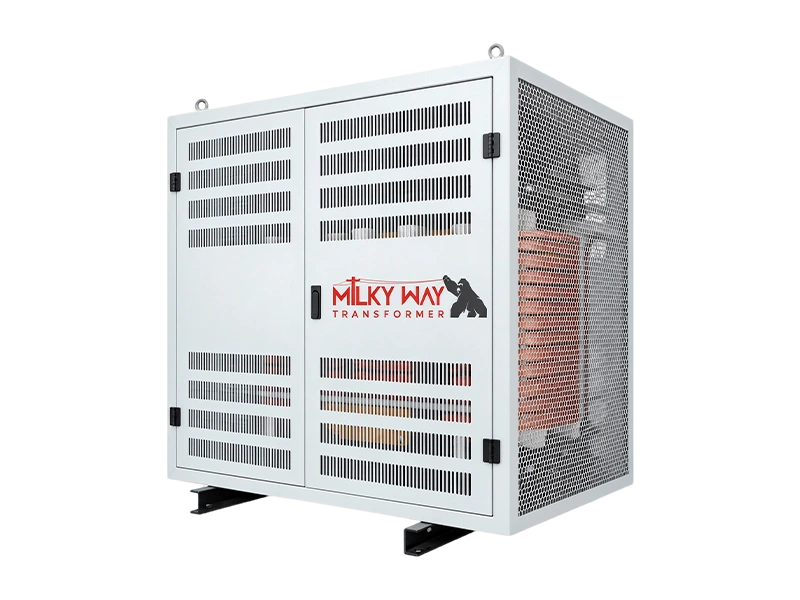
The newly released specifications for technical parameters and requirements for dry-type amorphous alloy core power transformers by relevant departments in 2026 will be officially implemented in 2027, putting forward more stringent specification requirements for the energy efficiency and reliability indicators of such products.
The current mandatory energy efficiency standard for power transformers that is being implemented was officially launched in 2025. The technical trend of the entire dry-type transformer industry is rapidly iterating towards ultra-low loss, low harmonic adaptation, and intelligent remote monitoring, to further adapt to the operation requirements of new power systems and provide more stable and reliable power support for various distribution scenarios.