




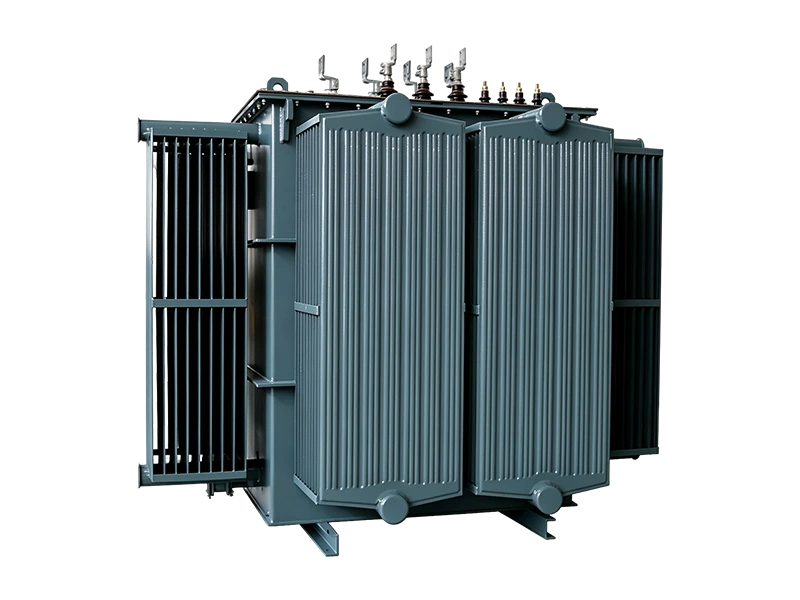
Power transformers are core primary equipment for energy conversion and voltage regulation in power grids, widely deployed in various scenarios such as substations, photovoltaic power plants, wind farms, and industrial distribution points, making them key large-scale equipment in the power transmission link. They can significantly reduce line losses in long-distance power transmission by stepping up or down voltage, ensuring safe power access for loads of different voltage levels. Due to their high overall cost and long fault repair cycle, internal faults of such equipment will cause enormous power outage losses, so they have always been a key focus of operation and maintenance management in power systems.
Core Working Principle
The operation of power transformers is entirely based on Faraday's Law of Electromagnetic Induction:
1. When an alternating current is passed through the primary winding, an alternating magnetic field is generated in the iron core laminated from high-permeability silicon steel sheets;
2. The changing magnetic field couples to the secondary winding, inducing a corresponding electromotive force in the secondary winding under the premise that there is no direct electrical connection between the two sides;
3. The output voltage is proportional to the number of winding turns: stepping up is achieved when the secondary winding has more turns, and stepping down is achieved otherwise.
In actual operation, equipment will generate iron core eddy current loss, winding resistance heating loss, etc., and the overall energy efficiency is generally at a high level, with transformers of large capacity and high voltage levels exhibiting more prominent operating efficiency.
Mainstream Classification
The most common classification method for power transformers is by insulating medium, and different types of products are adapted to different usage scenarios:
- Oil-immersed transformer: It is the mainstream category currently applied in power grids, using mineral insulating oil as the insulating and heat-dissipating medium, with low cost and high capacity upper limit, widely used in outdoor substations at all levels.
- Dry-type transformer: The winding is sealed by epoxy resin casting, without insulating oil, with excellent fire prevention and explosion-proof performance, mostly used in scenarios with high fire prevention requirements such as indoor power distribution rooms, building power distribution, and underground pipe galleries.
- Gas-insulated transformer: Using insulating gas as the cooling and insulating medium, mostly used in special compact fully-enclosed substation scenarios.
Core Structure
There are certain differences in the structure of different types of power transformers, among which the core components of oil-immersed transformers are the most complex:
1. Body part: Composed of a high-permeability silicon steel sheet iron core and high-low voltage copper/aluminum windings, it is the core for realizing electromagnetic energy conversion;
2. Insulating oil: It simultaneously undertakes the dual functions of insulation isolation and flow heat dissipation;
3. Protection components: Including devices for monitoring internal faults of the oil tank, devices for automatic pressure relief and explosion protection when fault pressure rises sharply, tap changers for adjusting output voltage to match grid requirements, and oil storage components adapted to the volume change of insulating oil at different temperatures;
4. Auxiliary components: Including heat dissipation devices for dissipating operating heat, high-low voltage bushings for realizing insulated lead-out of live leads and grounded oil tanks, and supporting temperature measurement and oil level monitoring devices, which can feed back the operating status of the equipment in real time.
The core components of dry-type transformers include iron cores, epoxy resin encapsulated windings, temperature-controlled start-stop fans, and protective shells, with a simple overall structure and no oil.
Typical High-Frequency Fault Defects
During the long-term operation of power transformers, several types of high-incidence fault defects may occur:
The first type is internal insulation deterioration, which causes insulation damage between turns/layers of windings due to long-term overheating, moisture, and short-circuit shocks. There are no obvious external signs in the early stage, and it can only be detected in advance through targeted monitoring methods, and will directly cause short-circuit burnout of windings in severe cases.
The second type is oil leakage, which causes the oil level to continue to drop due to aging of sealing gaskets, weld pinholes, and sealing failure of bushing bases, and moisture easily enters the oil tank to damage the internal insulation.
The third type is tap changer faults: poor contact and ablation of no-load tap changers, jamming and incomplete switching of on-load tap changers, which will cause three-phase resistance imbalance and local heating.
The fourth type is cooling system failure: damage to fans and oil pumps, and blockage of radiators due to dust accumulation lead to insufficient heat dissipation. Continuously high oil temperature will greatly accelerate insulation aging and shorten the overall service life of the equipment.
In addition, dry-type transformers have unique defects, such as cracking of epoxy resin encapsulation, poor heat dissipation and moisture of windings due to serious surface dust accumulation, and winding overheating caused by fan failure to start due to temperature control malfunction.
Operation and Maintenance Safety Red Lines and Inspection Points
There are clear core safety rules for the operation and maintenance of power transformers: after the core protection of an oil-immersed transformer trips, it is strictly forbidden to blindly re-energize without tests and oil sample analysis; during the operation of a dry-type transformer, it is strictly forbidden to cover with dust cloth or stack sundries to prevent blockage of heat dissipation channels.
Daily inspections also have clear key verification points: confirm that the oil level is in the normal range corresponding to the corresponding temperature, the oil color is clear without blackening, there is no abnormal sudden rise in top oil temperature or winding temperature, the operating sound is a uniform and low electromagnetic hum, there are no crackling discharge sounds or abnormal sounds of gas surging, there are no cracks or flashover marks on the bushings, and the start-stop logic of the cooling system fans and oil pumps is normal.