




Three-phase dry-type transformers are the core mainstream equipment in the current power distribution system field. The biggest difference from traditional oil-immersed transformers is that their iron cores and windings are completely not immersed in insulating oil. They rely on air convection and solid insulating media such as epoxy resin to achieve insulation and heat dissipation, and have irreplaceable application value in various power distribution scenarios.
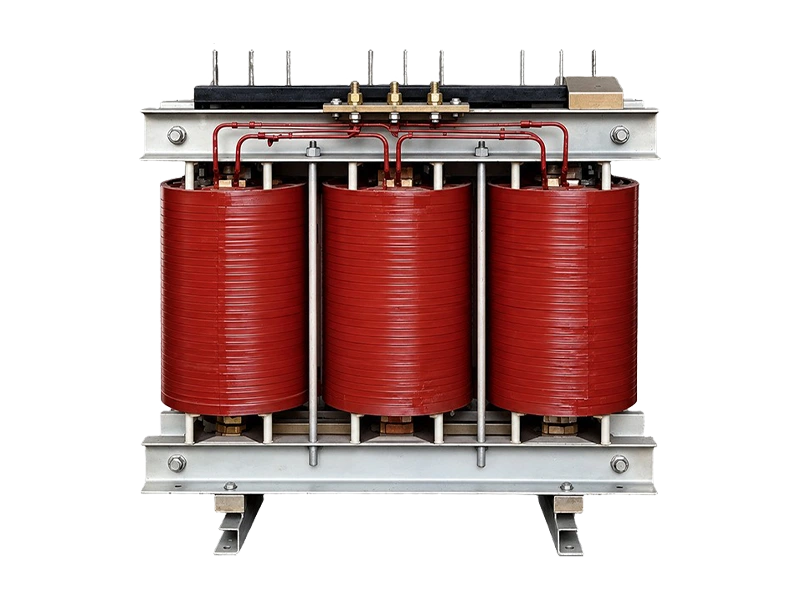
1. Core Advantages of Three-Phase Dry-Type Transformers
Compared with traditional oil-immersed transformers, the core advantages of this type of equipment are mainly reflected in three dimensions, which are also the core reasons why it has become the mainstream choice for current power distribution equipment:
First, it has outstanding safety performance. The equipment itself has no flammable fuel, features flame retardancy and self-extinguishing properties, and has a high fire and explosion protection rating. There is absolutely no risk of environmental pollution caused by insulating oil leakage, which can fundamentally avoid the fire and pollution hazards that may be caused by oil-immersed equipment.
Second, it is convenient for installation and operation and maintenance. The equipment has a compact overall structure and does not require additional supporting facilities such as oil pools and fire oil pits. It can be directly placed in ordinary power distribution rooms. The daily maintenance workload is much lower than that of oil-immersed products of the same specification, which can significantly reduce the long-term operation and maintenance costs of manpower and material resources.
Third, it has strong environmental adaptability. mainstream sealed casting products have excellent moisture resistance, pollution resistance and corrosion resistance, can easily adapt to various complex working conditions such as dusty, salt spray and high altitude, and are not affected by temperature and humidity changes in ordinary outdoor and semi-outdoor environments.
2. Mainstream Classification of Three-Phase Dry-Type Transformers
At present, the three-phase dry-type transformers commonly used in engineering scenarios can be divided into three categories according to insulation processes, which respectively adapt to different usage needs:
The first type is the ventilation and air-cooled type, which relies on natural air or forced circulation by fans to complete heat dissipation. It has a relatively low overall cost and is mostly used for ordinary power distribution scenarios in conventional indoor environments.
The second type is the epoxy resin casting type, whose windings are completely cured and sealed with epoxy resin material. It has excellent insulation strength, moisture resistance and pollution resistance. It is the category with the highest market share at present and can cover the usage needs of most commercial and industrial scenarios.
The third type is the fully sealed non-ventilated type, which is completely free of ventilation openings and relies on heat conduction on the shell surface to dissipate heat. It is specially adapted for high-risk special scenarios where there are conductive dust, corrosive gases, flammable and explosive media in the air.
In addition, according to the cooling method, they can also be divided into natural air cooling and forced air cooling. Among them, the forced air cooling type has better short-time overload capacity and can meet the demand of short-time unconventional power consumption; the mainstream products on the market currently have insulation levels that fully adapt to the temperature resistance requirements of different scenarios, and have sufficient guarantee for long-term operation stability.
3. Core Selection Points for Three-Phase Dry-Type Transformers
Combined with the latest industry selection specifications, when users purchase three-phase dry-type transformers, they need to focus on checking several core contents to avoid improper selection affecting the reliability of subsequent operation:
First, the reasonable reservation of rated capacity. When calculating the total power load, it is necessary to take into account the starting impact of inductive equipment such as motors and reserve sufficient capacity margin. If the proportion of inductive load in the scene is relatively high, the margin needs to be further expanded to prevent long-term overload from accelerating insulation aging and shortening the service life of the equipment.
Second, the matching of electrical parameters. For conventional scenarios, voltage levels adapted to civil and industrial power distribution systems are preferred. A suitable connection group label can effectively suppress tertiary harmonics and stabilize the neutral line voltage, meeting the usage needs of most scenarios. Only in special scenarios where the load is completely balanced can other adapted solutions be selected.
Third, the adaptation of protection level. For ordinary indoor scenarios, conventional protection levels are sufficient. For dusty workshops and semi-outdoor scenarios, products with higher protection levels are required. For coastal salt spray areas and new energy outdoor scenarios, anti-corrosion products should be selected. For plateau scenarios with an altitude of more than 1000 meters, special products adapted to plateau working conditions need to be selected, and corresponding capacity derating adjustments should be made.
Fourth, the selection of energy efficiency level. When purchasing, it is necessary to comply with the latest relevant national standards and give priority to high-energy-efficiency products.
Although the initial investment is slightly increased, long-term operation can significantly reduce no-load and load losses, and the additional investment cost can be recovered through saved electricity bills in a relatively short period of time.
4. Typical Application Scenarios of Three-Phase Dry-Type Transformers
At present, three-phase dry-type transformers have fully penetrated into various fields with high requirements for power supply safety and reliability, and there are corresponding adapted products for different scenarios:
In commercial complex and high-rise building scenarios, low-noise products are preferred, and the operating noise is controlled within a reasonable range to avoid noise disturbance to residents caused by daily operation;
In data center and IDC room scenarios, redundant configuration can be adopted, paired with forced air cooling systems to adapt to the requirements of low-energy operation;
In hospital and precision medical facility scenarios, products with low-harmonic design are selected to avoid interfering with various precision medical equipment and ensure the continuity of power supply;
In photovoltaic, wind power and other new energy power station scenarios, special step-up dry-type transformer products are selected, which can withstand the impact brought by power generation fluctuations and adapt to complex working conditions such as outdoor sand, dust, humidity and heat;
In rail transit station buildings and offshore ship platform scenarios, products that meet the requirements of special industry certifications are selected, which have the characteristics of high seismic resistance, impact resistance and strong corrosion resistance, meeting the usage standards of special industries.
5. Daily Operation and Maintenance Requirements for Three-Phase Dry-Type Transformers
During the normal operation of the equipment, it is recommended to support an automatic temperature control system to monitor the winding temperature in real time, regularly clean the dust on the surface of the equipment to ensure heat dissipation efficiency, and carry out a routine withstand voltage test once a year to complete various conventional performance test items, which can ensure the long-term stable operation of the equipment and achieve an ultra-long service life.