




A transformer is a core device that adjusts alternating current voltage based on the principle of electromagnetic induction, whose core components consist of a primary coil, a secondary coil and an iron core (magnetic core). It is usually marked with the letter T in circuit identification, and is an indispensable basic equipment in modern power transmission and distribution systems, widely used in daily civil power supply, industrial production power supply and small electronic circuits.
Core Working Principle
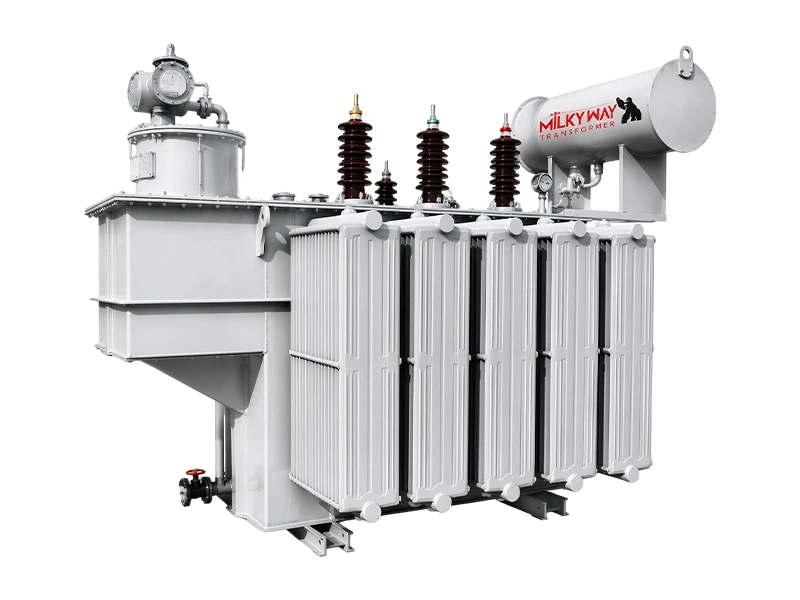
The operation logic of a transformer fully follows Faraday's Law of Electromagnetic Induction: when an alternating current is connected to the primary coil, an alternating magnetic flux will be generated in the iron core, which transmits the magnetic flux to the secondary coil with different turns, inducing an alternating current voltage of the same frequency as the input side. The voltage ratio of the primary side to the secondary side is approximately equal to the turns ratio of the coils on both sides, thus achieving the effect of stepping up or stepping down the voltage, and the frequency of the alternating current will not be changed during the whole working process. If various losses under ideal working conditions are ignored, the relationship between them can be intuitively expressed by the formula: U1/U2 = N1/N2, where U represents voltage and N represents the number of coil turns.
Main Functions
The functions of transformers cover multiple links of power transmission and electronic circuit operation, and the core functions are mainly divided into four categories:
The first category is the voltage conversion function. Through step-up processing, electric energy is converted into the form of high voltage and low current, which greatly reduces the electric energy loss during long-distance power transmission. After the electric energy is delivered to the power consumption end, it is then stepped down step by step to adjust to the voltage suitable for different scenarios, which is the core foundation for stable power transmission of cross-regional power grids.
The second category is the current and impedance conversion function. It adjusts the current magnitude synchronously while adjusting the voltage, and can also realize impedance matching in various electronic circuits to optimize the signal transmission efficiency.
The third category is the electrical isolation function, which can cut off the direct electrical connection between the circuits on both sides, reduce the propagation range of faults, greatly lower the risk of electric shock, and improve the safety factor of the entire circuit.
The fourth category is the voltage stabilization function. A magnetically saturated transformer can stabilize the voltage level on the output side in scenarios with large fluctuations in input voltage, providing a stable power supply environment for subsequent electrical equipment.
Mainstream Classification
Transformers on the market can be divided into multiple categories suitable for different scenarios according to different classification standards:
If classified by cooling and insulation methods, there are three most common types: first, dry-type transformers, which use epoxy resin casting for insulation and rely on air convection for heat dissipation, with a high fire protection rating, suitable for scenarios with high fire safety requirements such as high-rise buildings, residential dense areas, nuclear power plants and offshore platforms; second, oil-immersed transformers, which use insulating transformer oil as a cooling medium, with strong heat dissipation capacity, mostly used in scenarios with large power loads such as outdoor substations and heavy industrial plants; third, amorphous alloy transformers, whose iron core is made of special amorphous alloy material, with extremely low no-load loss, very suitable for scenarios with long-term operation at low load rate, and have excellent energy consumption performance in long-term use.
If classified by purpose, they are mainly divided into two categories: power transformers and special transformers. Power transformers are applied in the whole link of power transmission and distribution, and can be widely adapted to various conventional power consumption scenarios in industry, agriculture and urban communities; special transformers cover categories such as transformers for smelting electric furnaces, withstand voltage test transformers for testing, transformers for measurement, and transformers dedicated to communication and high-frequency electronic equipment, which can meet the special use needs of various industrial processing and electronic circuits.
Development History
The ""induction ring"" invented by Faraday in 1831 was the earliest prototype of transformers. Initially, it was only used to demonstrate the principle of electromagnetic induction and was not put into practical application. By 1885, engineer William Stanley manufactured the first practical power transformer, which was commercialized in 1886.
The large-scale popularization and application of transformers directly solved the core problem of long-distance economical transmission of alternating current, allowing power plants to be located in energy production areas far away from cities without being restricted by the need to be close to the power consumption end, thoroughly promoting the popularization of modern power systems and laying a solid foundation for the current power supply network that stably covers the whole society.
In different usage scenarios, as long as people select the appropriate transformer category according to their own installation environment, load characteristics and safety requirements, it can not only ensure the stability of long-term operation of the equipment, but also effectively control the use cost of the whole life cycle.